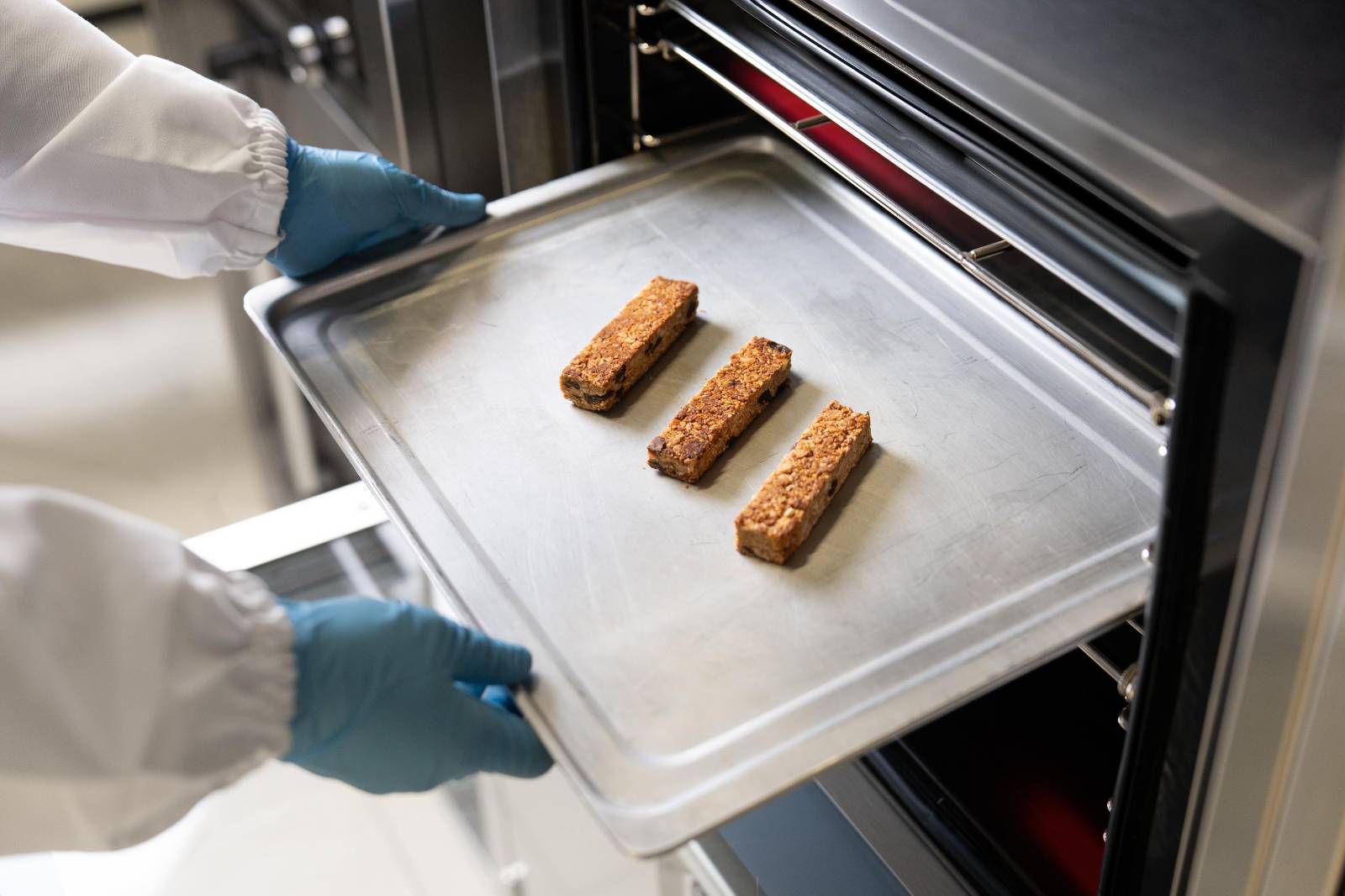
Reducing sugar sounds simple on a spec sheet. In the lab, it rarely is. Formulate a genuinely good sugar-reduced product, and you’re not swapping one ingredient for another, you’re rebuilding the product from the inside out.
Sugar Does More Than Sweeten
Sucrose isn’t just taste. In a formulation, it’s a multitasking ingredient that shapes structure and bulk, controls mouthfeel and viscosity, depresses the freezing point in frozen desserts (which is why ice cream stays scoopable instead of turning into a solid block), and drives colour and flavour through the Maillard reaction and caramelisation [1]. Pull sugar out, and every one of those functions goes with it. That’s the real problem hiding behind a seemingly straightforward reformulation brief.
How the Industry Solves It Today
Because no single ingredient reproduces all of sugar’s roles, most sugar-reduced formulations today lean on blends of several ingredients, each assigned to a different job. Stevia is brought in to deliver sweetness. Erythritol adds bulk and body to replace the volume that sugar used to provide. Fibres such as inulin and polydextrose are layered in to rebuild texture and structure. Each ingredient solves a fragment of the puzzle, but stacking several of them together also means stacking several sets of trade-offs, and a formulation that becomes considerably harder to balance.
The Trade-Offs Nobody Puts on the Slide
Stevia can carry a bitter or liquorice-like aftertaste. Researchers at the Technical University of Munich and the German Institute of Human Nutrition identified two specific bitter-taste receptors, hTAS2R4 and hTAS2R14, that steviol glycosides activate alongside the sweet receptor, which is why the sweetness and the bitterness arrive together, on the same tongue, from the same molecule [2].
Erythritol brings a cooling sensation that isn’t always welcome outside confectionery and gum, and its digestive tolerance is more limited than marketing decks tend to suggest. In 2023, EFSA re-evaluated erythritol’s safety and lowered the acceptable daily intake to 0.5 g per kg of body weight, specifically to guard against its laxative effect and the electrolyte imbalance that can follow repeated exposure [3].
Maltitol and other polyols (sorbitol, xylitol) carry the same category-wide caveat. Under EU Regulation 1169/2011, any food containing more than 10% added polyols must carry the label “excessive consumption may produce laxative effects” [4], a regulatory fact, not a scare story, but one that shapes how much of these ingredients a formulator can realistically use.
Fibres like inulin and polydextrose aren’t neutral fillers either. Peer-reviewed rheology studies show they measurably change a product’s viscosity and structure: inulin tends to lower peak viscosity while strengthening the viscoelastic network, and polydextrose tends to do the opposite, so swapping one for the other isn’t interchangeable, and either one reshapes texture in ways that have to be re-tested, not assumed [5].
Put together, sugar reduction often turns into a search for the least-bad compromise between taste, texture, technological function and nutritional profile.
But is that trade-off actually unavoidable?
The market increasingly says no, sugar-reduction claims in new food and beverage launches have kept climbing, with Europe leading the way, a sign that “reformulate without breaking the product” has become table stakes, not a nice-to-have [6].
What We’re Hearing From the Industry Itself
This isn’t just literature. Over the past months, we’ve talked to more than 20 Food & Beverage companies across Italy, Europe and globally, including US-based ones, about how they’re approaching sugar reduction today.
Four problems come up again and again.
The first is taste and aftertaste. Intense sweeteners often leave bitter, metallic or liquorice-like notes that consumer panels flag immediately, undermining the very sensory profile a brand is trying to protect.
The second is texture and structure. Once sugar is pulled out, products lose bulk, mouthfeel and the freezing-point behaviour that kept frozen and aerated formulations stable and pleasant to eat, and rebuilding those properties with other ingredients is rarely a clean swap.
The third is digestive tolerance combined with regulatory constraints. How much of a given polyol a formulator can use is capped both by how much the gut can comfortably handle and by the mandatory labelling thresholds that come with certain concentrations, which narrows the usable dosing window considerably.
The fourth is formulation complexity. Balancing several ingredients inside a single blend, each one solving a narrow slice of the problem, stretches development timelines and pushes up cost, often to the point where a reformulation project stalls before it ever reaches the shelf.
These aren’t abstract technical footnotes. They’re the reasons reformulation projects get shelved.
A Third Way
This is the problem LOOOPS set out to solve differently.
Instead of stacking one ingredient per function, we’re developing BITELOOP, a single ingredient made by fermenting upcycled broken rice, engineered to contribute to several functions of a formulation at once: sweetness, technological functionality (bulk, structure, mouthfeel), and nutritional profile, together. In lab-scale trials, BITELOOP has delivered roughly a 30% reduction in simple sugar on a 1:1 replacement basis, validated across more than eight applications in the labs, from ice cream to protein bars, chocolate-hazelnut spreads and biscuits.
The goal isn’t to find yet another sweetener, but to rethink what role an ingredient plays in a formulation in the first place.
Let’s Talk
If you’re working on new Food & Beverage products and wrestling with the sugar-reduction challenge, let’s talk: info@looopsfoodlab.com, or reach out to us on LinkedIn.
Sources
- EUFIC, What is the role of sugar in the food industry?
- FoodNavigator, reporting on Hofmann et al., J. Agric. Food Chem., Taste receptor discovery could help industry ease the bitter taste of stevia
- EFSA Journal (2023), Re-evaluation of erythritol (E 968) as a food additive
- Cargill, citing Regulation (EU) No 1169/2011, EU Labeling and Legislation for polyols
- Zdaniewicz et al., PMC/NCBI, Effect of Prebiotic Polysaccharides on the Rheological Properties of Reduced-Sugar Potato Starch-Based Desserts
- FoodIngredientsFirst / Innova Market Insights, Sugar reduction claims grow